Showing posts with label duncan. Show all posts

Sunday, April 25, 2010

My First Visit to Marxhausen's Studio


Anne Marxhausen informed me that Reinhold often assigned his ceramic students to sculpt shoes out of clay. These are likely by his students.


This is a model for the mural in the Lincoln Community Playhouse, which I wrote about here.


[Edit: I just learned that this red pipe was constructed by Reinhold's son, Karl Marxhausen.]


John the Revelator, work by a student


Thursday, April 1, 2010

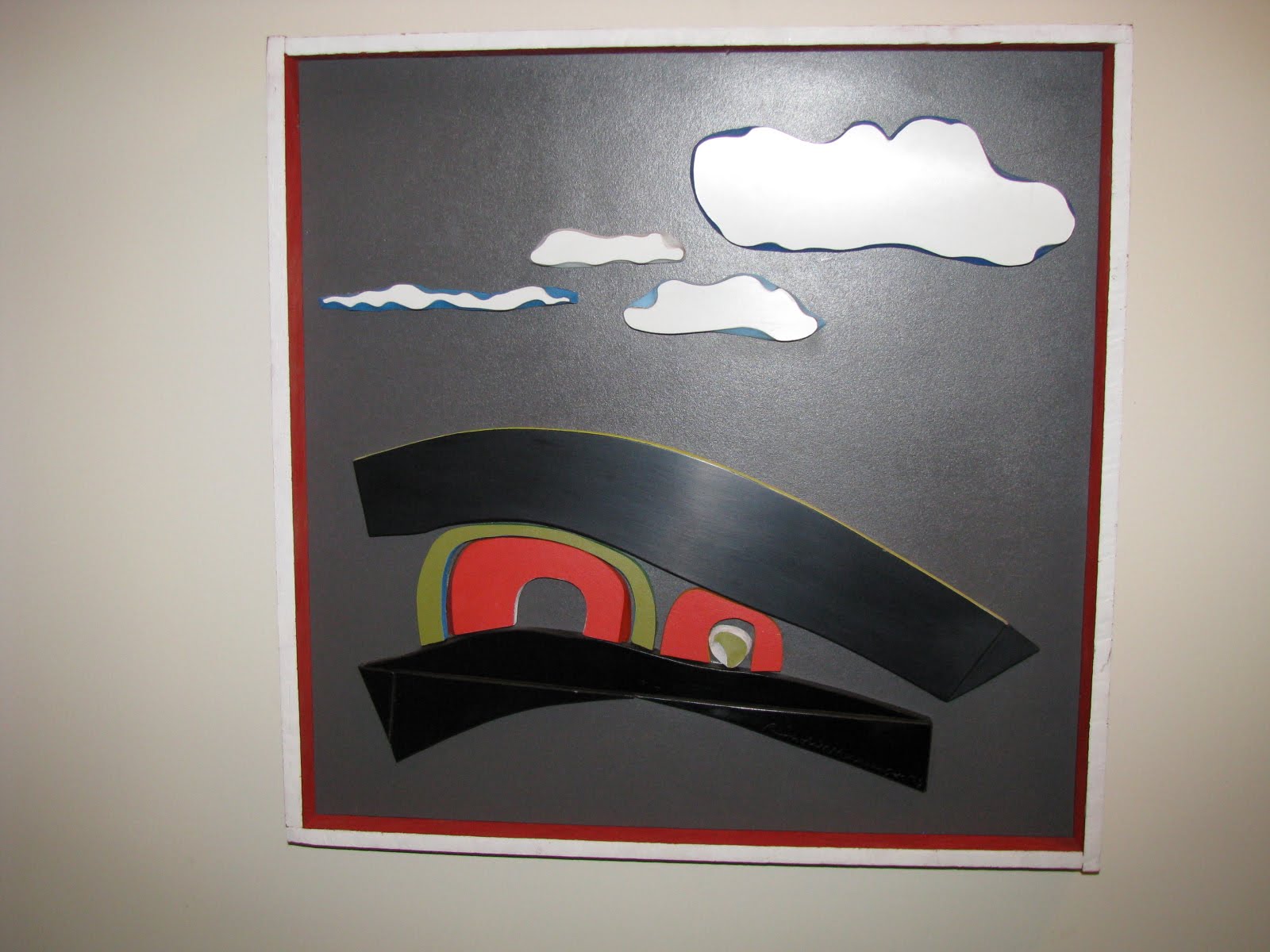
Formica Piece


This was commissioned by Gary Greinke, who was Assistant to the President of CUNE in 1973. He gave it as a gift to a member of Concordia's staff, Lynda Parde, to celebrate the birth of her daughter.

According to Parde, this is the symbolism of Marxhausen's piece:

The two black arcs represent the earth. The top arc is the old soil and the bottom glossy arc represents new soil that is fertile. Between the two arcs there are two forms with the one on the left representing the man and the one on the right representing the woman. The woman is with child and will soon give birth. The parallel explanation refers to seeds planted under top soil in fertile ground that will develop and will break through the outer surface of the soil into new plants when conditions are right.

This blog is the only place you'll be able to find some of these artworks.

- Duncan

Wednesday, March 17, 2010

Marxhausen's Clay Busts of Professors


Marxhausen once tried to sculpt clay busts of all the Concordia professors. After doing a few, Marxy realized the task would be far more time-consuming than he anticipated, so he moved on. Here is one completed bust owned by Prof. Pfabe. What other professors did Marxy sculpt? I'll be looking into that in the future.

- Duncan

Friday, March 5, 2010

The Sower


This Marxhausen piece hangs in the Teachers' Learning and Education Center at CUNE. When they saw me photographing this piece, several faculty and staff at TLEC began to reminisce about Marxy, and I gleaned some great information.

The back contained basic information such as the artist and title, Marxhausen gave it the simple title of "The Sower," and the listed media was glass and plexiglass.

He also used wood and possibly Formica, which is also used for counter-tops. Lynda Parde recalled Marxhausen also used Formica in a piece which he gave to her in 1973. From this information, I learned that Marxhausen was going through a "Formica phase" in the early 1970s.

It was clearly inspired by Christ's parable of the sower:

Then he told them many things in parables, saying: 'A farmer went out to sow his seed. As he was scattering the seed, some fell along the path, and the birds came and ate it up. Some fell on rocky places, where it did not have much soil. It sprang up quickly, because the soil was shallow. But when the sun came up, the plants were scorched, and they withered because they had no root. Other seed fell among thorns, which grew up and choked the plants. Still other seed fell on good soil, where it produced a crop—a hundred, sixty or thirty times what was sown.' Matthew 13:3-8 (NIV)

This piece was photographed and included in a series of posters shared with LCMS teachers across the country, However the original is not just a flat, two-dimensional image, so one can appreciate it better by looking at it from more than one angle:


- Duncan

Wednesday, February 24, 2010

Marxhausen's Lent Art 2


There's minimal differences between these two photos, but I thought I'd post both anyway.

This piece uses the "flurries" Marxhausen loved to work with. One of Amber's post gave you a look inside Marxy's studio where students got to play with these flurries.

- Duncan

Wednesday, February 17, 2010

Lent


Today is Ash Wednesday!

This piece by Marxhausen commemorates Lent.

I was curious if there were 40 colored pieces, but the number was well over that.

Its dark background may have been chosen because the color black is used to symbolize Christ's death on Good Friday. I see a cross-shape created by the rubber band stretched across the brightly colored pins. Prof. Anschutz recalled that Marxhausen made this cross lop-sided, and the rubber bands essentially submit to gravity and sag, representing the sin that made Christ's sacrifice a necessity.

- Duncan

The Open Book


I love the sun! After days of gloomy, cloudy days, it finally peeked through on Ash Wednesday! This sculpture by Marxhausen was photographed around 1:10 p.m.

Note how the snow in the first is so close to the color and texture of the statue, you don't notice it until you look at the right half of the picture, where sunlight reflects off of just the snow.

[Update] One of Marxhausen's former students remembered that Marxy would run around campus taking photographs when it would start to snow, then ask his class about to find compositions and elements of design in the photos. Isn't it strange that I observed the way snow affected his Open Book sculpture before hearing this story? You can read the story in the "What do you remember?" section.


4:10

- Duncan

Saturday, February 13, 2010

Ash Wednesday and Art for Lent

Ash Wednesday is this week, and I plan to share photos of Marxhausen's artwork honoring Lent every week leading up to Easter. Be sure to check back this Wednesday to see the first photos in this series!

-Duncan

Thursday, February 4, 2010

My Own Little World

We all have our own unique, little miniature world.

Quote by Marxhausen during interview for "Time Lines."

You've probably seen a lot of t-shirts with funny messages printed boldly on the front. Some of those shirts can be insipid, but one I've seen which I can identify with says this: "I live in my own little world, but that's okay, they know me there."

Often, I find myself slipping off into my own little world, sometimes even something in a conversation can spark my imagination, and suddenly I'm gazing at nothing. I agree with Marxy that everyone has there own little world; it's just that some people spend more time there than others. For an artist, this time spent reflecting on what our eyes have taken in is even more important.

When Leonardo da Vinci was in the process of painting his ill-fated masterpiece, The Last Supper, one of the monks grew impatient because Leonardo spent so much time staring blankly and seemingly getting nothing accomplished. Leonardo defended himself in a sharp letter to the monk's superior, explaining that these times of mental contemplation were even more important than applying the paint.

One of my Professors explained that painting is an intellectual process; you have to have a plan.

It seems to me when Marxhausen went into his own little world, it was because he was observing something fleetingly beautiful in nature. He spent hours talking about his ideas of beauty and light in interviews for documentaries, and that was a recurring theme. When he spent time in his own little world, Marxy could find art in pencil boxes, coat hangers, and piles of napkins.

- Duncan

Sunday, January 31, 2010

Before I Knew Marxy, I Knew his Work

As a freshman, I played Peter in a Lincoln Community Playhouse production of "The Lion, The Witch, and the Wardrobe." The Playhouse often exhibits professional artwork, and I took the opportunity to admire their galleries whenever I was there. However, it was one of their permanent works that never failed to intrigue me.

It's important to know what the walls of the Playhouse look like, since they inspired the piece. The white walls are not flat; vertical grooves around three inches deep line the Playhouse's entrance. The artwork is an extension of these walls, pushing forward in space and interrupting the nice, repeating pattern. The work also features mirrors arranged into a wave-like pattern. As different people mill about the theater, the mirrors constantly reflect shifting, distorted shapes of color. It never looks exactly the same way twice.

I could just stand and stare at that thing and lose track of time, slightly perplexed by it's meaning, but always intrigued by it's forceful presence.

Imagine my surprise, years later, to learn that it was Marxhausen who created this work!

Furthermore, as I learned more about Marxhausen's worldview and understanding of art, the mysterious work finally began to make sense. Marxy loved to take walks in nature, and study how things changed as time passed and the light changed.

To demonstrate how dramatically objects' appearances can change, Marxhausen took photos of a seemingly dull subject in his house: a plain white kitchen cupboard. On different mornings, he would photograph the same cabinet from the same angle, but it never looked quite the same in each photo. The light struck the handles differently each morning, and the variety of the dark shadows and the reflected light was something remarkably beautiful.

Light changes things, even simple things we’re confronted with every day. There’s beauty in the changes light brings about: there’s so many interesting things to see in a day. There’s never any reason to get bored with your surroundings, whether you’re in an office building or on a farm. You have to work at seeing. It must be an aggressive act of visual curiosity. Things are always changing, so you have to learn to see things as they are right now. Combinations and relationships of form, colors, textures, and lines. When you try to see things this way, no matter where you are you can be rewarded with moments of unexpected joy during the day.

(Marxhausen speaking in an interview for A Time to See)

That's the appeal of his art at the Playhouse. Rather than creating something static and unchanging, Marxy created a non-objective work of art which mimics nature: it is always changing.

Imagine, before I even knew who Marxhausen was, his work was already helping me see the world in a new light. That's the mark of a gifted artist.

- Duncan

Saturday, January 30, 2010

New Writer

Greetings! I'm honored to be contributing to this wonderful site.

Amber Konz, the founder of this blog, is a remarkable person, and has been a mentor for younger art students at Concordia, myself included.

Like Amber, I have learned a great deal from Marxhausen, even though I arrived at Concordia years after his retirement. The more I learn about Marxy, the more he impresses me with his wisdom, his artist's eye, and his ability to witness his faith through his art.